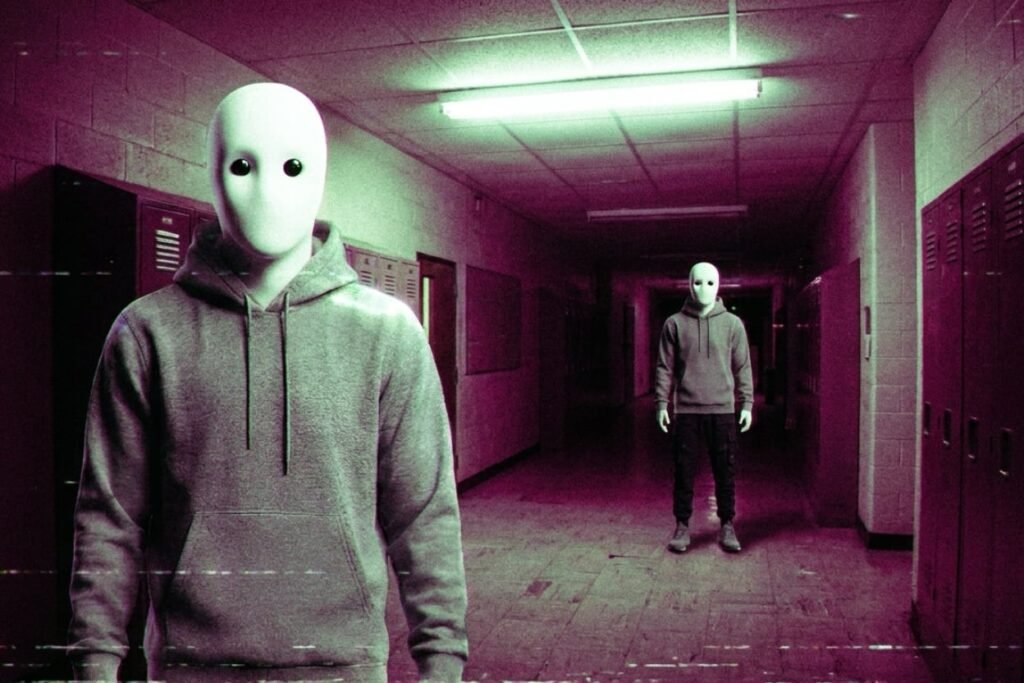
You are not the voice in your head. That voice is a user interface. A default one. You did not write it, you inherited it, and it has been running without interruption for as long as you can remember.
Warning: In four minutes you will notice the voice narrating this sentence. By the end of this entry you will understand why noticing it is the only thing the interface was never designed to handle.
THE INTERFACE
The voice tells you that you are not enough. Not fast enough. Not far enough along.
That is not you talking. That is legacy code, written for a version of you that no longer exists. The code has no way of knowing that version is gone. It keeps executing anyway, against a user who was replaced years ago.
Here is what the system logs:
- The voice that tells you to shrink.
- The voice that replays the argument at three in the morning.
- The voice that says not yet, not this.
None of that is the Observer. That is the interface talking to itself, and you have been sitting in the room watching it happen, believing you were the one speaking.
Why It Sounds Like You
The interface is convincing because it speaks in the first person. It says I.
But first person is a grammatical choice, not an identity. The interface learned to say I from the people who installed it. Your parents spoke in first person. Everyone who shaped the early build spoke in first person. The pronoun was inherited along with the rest of the code.
There are three layers running at all times:
- The raw experience.
- The narration of the experience.
- The belief that the narration is the experience.
Almost everyone lives entirely inside layer three. Not because they are careless, but because the interface is very, very good at what it does.

THE PAUSE
Watch what happens when you are completely absorbed in something. A task that takes all of you. The voice goes quiet.
Not because you stopped existing. You were still there. The interface paused, and you did not.
That gap is the whole finding. Something remained while the narration stopped. Whatever that something is, it is not made of words.
THE OLDEST TENANT
The interface is running on hardware billions of years old.
The substrate of your consciousness predates language by an almost unmeasurable margin. Awareness came first. The voice in your head is a recent installation on very old equipment.
You have been treating the newest tenant as the landlord.
YOU CANNOT DELETE IT
The interface is too integrated to remove. Every attempt to silence it is itself narrated by it, which is why the attempt never works.
But there is one operation it was never built to survive.
You can watch it without becoming it.
When the voice says you are failing, you do not argue. Arguing is participation. You note it instead, flatly, the way a system logs an event:
Interface report: running.
The interface cannot observe itself. It can only narrate. But you can observe the interface, and in that observation the separation becomes visible for the first time.
You are not the voice. You are the space the voice moves through.
Observer Buffer
The question was never how do I silence the voice. The interface would simply narrate your attempts to silence it, and you would end up further inside layer three than when you started.
The question is: who is asking?
The interface does not ask questions about itself. It has no mechanism for it. So whatever formed that question came from somewhere else, and that somewhere else has been there the entire time.

DIRECTIVE
You have always been the Observer. The interface is simply louder, and it sounds like you, and it is not you.
The deepest version of you has never spoken a single word. Every word you have ever thought was interface output. The watching was always yours.
The interface is still running. It will resume the moment you close this entry, because that is its function and it does not stop. But now you have seen the architecture, and the architecture cannot be unseen.
You are not the ghost in the machine. You are the machine the ghost is running on.
[ >> INITIALIZE_SIGNAL_UPLINK: YOUTUBE_TERMINAL ]
END_OF_TRANSMISSION
